









Introduction
The easyjet flight u2238 emergency landing newcastle deserves attention for one simple reason: the crew made a decision that placed passenger welfare ahead of keeping the flight on schedule. Headlines often make emergency landings sound dramatic, but the facts behind this incident point to something far more important. A timely diversion, a safe landing, and a coordinated medical response achieved exactly what commercial aviation is designed to do when an unexpected situation develops in the air.
The flight changed course before reaching Manchester
easyJet flight U2238 was operating on a scheduled route from Copenhagen to Manchester when the situation onboard changed. During the journey, the flight crew declared an emergency and diverted the aircraft to Newcastle International Airport instead of continuing directly to its planned destination.
Available reports indicate that the diversion was linked to a passenger requiring urgent medical attention rather than a technical issue with the aircraft. That distinction matters because emergency declarations are not limited to mechanical faults. They also allow flight crews to request priority handling when a person’s health is at risk.
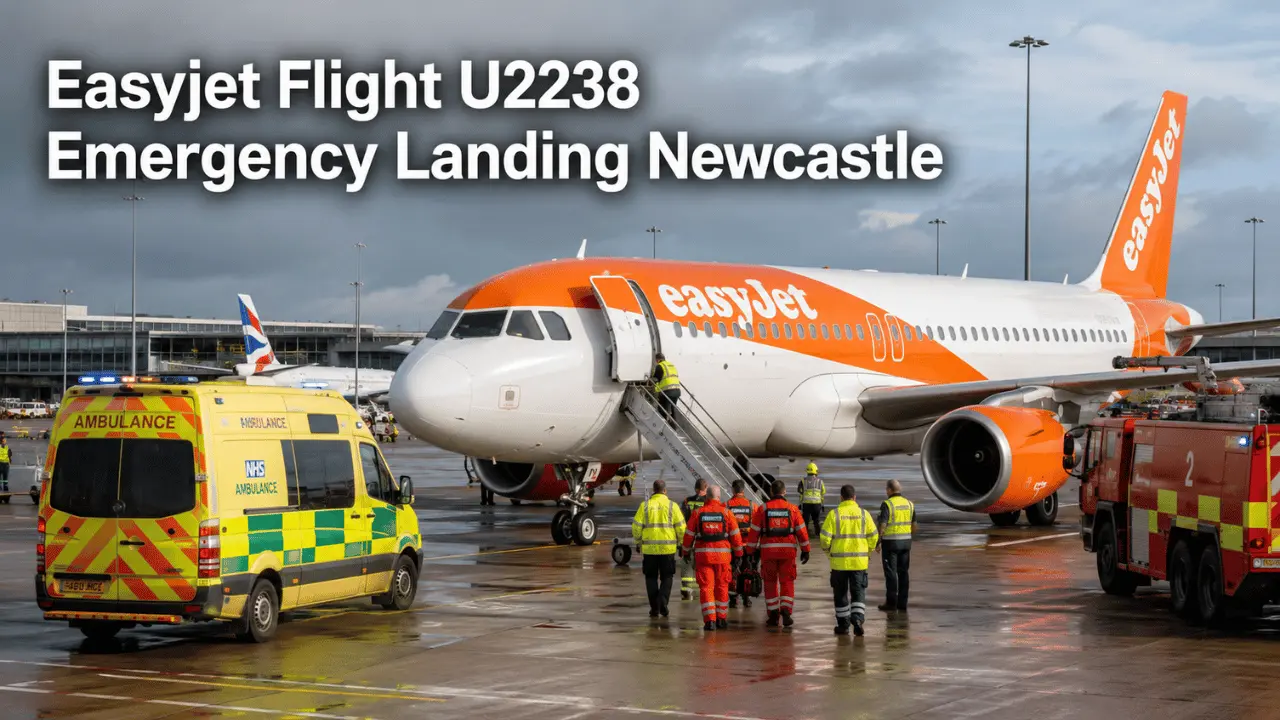
The easyjet flight u2238 emergency landing newcastle ended with the aircraft touching down safely, where emergency medical teams were ready to respond immediately after arrival.
Why Newcastle became the safest choice
People unfamiliar with airline operations often assume that a flight should always continue to its original destination if it is relatively close. In reality, pilots make decisions based on the safest and fastest option available at that moment.
For the easyjet flight u2238 emergency landing newcastle, Newcastle offered a practical solution. The airport was well positioned along the aircraft’s route and capable of providing immediate emergency support. Choosing the nearest suitable airport reduced the time before medical professionals could reach the passenger.
Every diversion involves a careful assessment of several factors, including:
- Distance to nearby airports
- Weather conditions
- Runway availability
- Air traffic conditions
- Emergency response capability
- The condition of the affected passenger
These decisions are made within minutes and rely on training, operational procedures, and communication between pilots, cabin crew, air traffic controllers, and airport authorities.
A medical emergency is different from an aircraft emergency
One of the biggest misconceptions surrounding the easyjet flight u2238 emergency landing newcastle is the assumption that declaring an emergency automatically means the aircraft itself is in danger.
That is not how commercial aviation works.
Pilots can declare an emergency whenever immediate priority handling is needed. A passenger suffering a serious medical event can justify that decision just as much as a technical malfunction.
Commercial aircraft carry emergency medical equipment, and cabin crew receive training to manage health-related incidents during flight. Even so, there are situations where onboard care is only the first step. If a passenger needs hospital treatment without delay, diverting the aircraft becomes the safest course of action.
That appears to be exactly what happened during the easyjet flight u2238 emergency landing newcastle.
What happens after a crew declares an emergency
The moment an emergency is declared, several processes begin almost simultaneously.
Air traffic control gives the aircraft priority over surrounding traffic whenever possible. Controllers coordinate a direct approach, reduce unnecessary delays, and inform the destination airport about the nature of the situation.
At the airport, emergency personnel prepare before the aircraft lands. Medical teams position themselves so they can reach the affected passenger as quickly as possible. Ground operations also prepare for the arrival, ensuring that the aircraft can be guided efficiently after landing.
Because of this coordinated response, the easyjet flight u2238 emergency landing newcastle moved from an airborne medical concern to immediate professional care within a short period after touchdown.
Passengers often notice emergency vehicles waiting near the runway, but most of the coordination happens long before the aircraft becomes visible from the ground.
Cabin crew become the first medical responders in the sky
Flight attendants do far more than provide customer service.
When a medical emergency develops at cruising altitude, cabin crew become the first people responsible for assessing the situation, providing first aid, communicating with the flight deck, and reassuring other passengers.
During incidents like the easyjet flight u2238 emergency landing newcastle, every member of the crew has a defined role. While the pilots focus on safely navigating the aircraft and coordinating with air traffic control, the cabin crew remain with the passenger, monitor their condition, and relay updates to the cockpit.
If there is a doctor, nurse, or other qualified medical professional travelling as a passenger, the crew may ask for assistance. Even then, the cabin crew continue to manage the situation under established airline procedures.
That teamwork allows critical decisions to be made quickly without creating unnecessary panic inside the cabin.
Why passengers should not panic during a diversion
The word “emergency” naturally attracts attention, but it does not always signal immediate danger to everyone onboard.
The easyjet flight u2238 emergency landing newcastle demonstrates that an emergency declaration can simply be the fastest way to secure priority landing and urgent medical assistance.
From a passenger’s perspective, a diversion is inconvenient. From a safety perspective, it is often the most responsible choice available.
Modern airline procedures are built around acting early rather than waiting for a situation to become more serious. That philosophy has helped commercial aviation maintain one of the strongest safety records in the world.
Choosing to land sooner instead of later is not an overreaction. It is exactly what well-trained crews are expected to do when passenger welfare is on the line.
What happened after the aircraft landed in Newcastle
Once the easyjet flight u2238 emergency landing newcastle reached Newcastle International Airport, the priority shifted from getting the aircraft on the ground to helping the passenger who required urgent care.
Emergency medical teams were already in position before the aircraft came to a stop. That preparation is standard practice whenever flight crews declare an emergency. Instead of losing valuable minutes after landing, medical personnel can board the aircraft almost immediately and begin assessing the passenger.
For everyone else onboard, the landing marked the end of the most uncertain part of the journey. Although passengers were not arriving where they had expected, they had reached an airport where professional assistance was immediately available. In situations involving a medical emergency, that outcome is far more important than staying on schedule.
Reports available after the incident indicated that the aircraft itself had not suffered a technical failure. Once the medical situation had been addressed and operational checks were completed, the flight was able to continue toward Manchester.
Continuing to Manchester after the diversion
One question frequently raised after the easyjet flight u2238 emergency landing newcastle was whether the aircraft could safely continue its journey.
The answer depends entirely on why a diversion takes place.
If an aircraft lands because of a mechanical issue, engineers may need to inspect or repair it before another departure is approved. A medical diversion follows a different process. Once the passenger receives the necessary assistance and the flight crew complete required operational procedures, the aircraft can continue if it remains fully serviceable.
That appears to have been the case here. After the emergency response in Newcastle, the aircraft later departed and completed the final section of the journey to Manchester.
Although passengers experienced an unavoidable delay, they still reached their destination without the need for a replacement aircraft.
Why pilots never delay a decision like this
Commercial pilots face decisions that have to be made within minutes.
When a passenger’s condition begins to deteriorate, waiting to see whether things improve is rarely the safest option. Every extra minute in the air means extra time before doctors, paramedics, and hospital facilities become available.
The easyjet flight u2238 emergency landing newcastle highlights why pilots are trained to act early rather than react late.
A diversion is not considered a failure to complete a flight. It is evidence that the crew recognised changing circumstances and selected the safest available option.
That mindset is one of the strongest reasons commercial aviation continues to achieve such a high level of operational safety.
Air traffic control plays a crucial role
Passengers rarely hear the conversations taking place between pilots and air traffic controllers, yet those exchanges become especially important during an emergency.
After the crew declared an emergency, controllers would have prioritised the aircraft’s arrival into Newcastle. That can include assigning a direct route, reducing holding time, coordinating with other aircraft, and ensuring the runway is available when the flight arrives.
This cooperation helps remove unnecessary delays at a point when every minute matters.
The easyjet flight u2238 emergency landing newcastle demonstrates how aviation safety depends on coordination between people who may never meet face to face but work together continuously throughout a flight.
How emergency services prepare before touchdown
Emergency vehicles waiting near a runway often attract attention from passengers looking through the windows.
What they do not see is the preparation that has already taken place.
Before the aircraft lands, airport teams receive information about the nature of the emergency. Medical responders prepare equipment, airport operations staff organise access routes, and emergency personnel position themselves so they can reach the aircraft without delay.
This organised response is designed to reduce waiting time after landing.
During the easyjet flight u2238 emergency landing newcastle, those preparations meant that assistance was available as soon as the aircraft reached its parking position.
The experience from a passenger’s perspective
Passengers on diverted flights often experience uncertainty long before they receive detailed information.
An unexpected change of destination naturally raises questions.
People wonder whether the aircraft has developed a fault, whether there is danger onboard, how long the delay will last, or whether they will still reach their final destination that day.
Good communication from the flight crew can make a significant difference.
Clear announcements help passengers understand that a diversion is a precautionary measure designed to protect someone onboard rather than a sign that the aircraft itself is unsafe.
Although the easyjet flight u2238 emergency landing newcastle interrupted travel plans, the successful landing and continuation of the journey demonstrated that established airline procedures were working exactly as intended.
Why incidents like this receive public attention
Any flight that declares an emergency quickly appears on flight-tracking websites and social media.
People notice unusual flight paths, emergency codes, or unexpected landings long before official information becomes available. That often leads to speculation, particularly when details are still limited.
The easyjet flight u2238 emergency landing newcastle became a talking point because emergency declarations naturally attract public interest. As additional reports emerged, the focus shifted toward a passenger medical emergency rather than concerns about the aircraft itself.
That distinction is important because it changes the entire context of the incident.
The safest outcome was achieved not because nothing happened, but because the crew responded before the situation had the chance to become worse.
What travellers can learn from this incident
Medical emergencies can occur on any commercial flight, regardless of distance or destination.
Passengers can reduce potential complications by carrying essential medication in their hand luggage, informing travelling companions about important medical conditions, staying hydrated during longer journeys, and notifying cabin crew immediately if someone becomes seriously unwell.
Delaying that conversation rarely helps.
Flight attendants are trained to respond, and early notification gives both the cabin crew and pilots more time to assess available options.
The easyjet flight u2238 emergency landing newcastle also reminds travellers that changing plans for one passenger can protect everyone onboard. A delayed arrival is a minor inconvenience compared with the consequences of postponing urgent medical care.
The real significance of this diversion
The easyjet flight u2238 emergency landing newcastle was not defined by panic, confusion, or mechanical failure. It was defined by disciplined decision-making.
The crew recognised that a passenger needed urgent medical assistance, declared an emergency, diverted to the nearest suitable airport, landed safely, and ensured emergency responders could provide immediate care. After the situation had been resolved, the aircraft continued to Manchester.
That sequence reflects the strength of modern airline procedures.
The next time passengers hear that a flight has diverted because of an emergency, it is worth remembering that such decisions are made to reduce risk rather than respond to disaster. Acting early is often the reason an incident ends quietly instead of becoming something far more serious.
Frequently Asked Questions
1. Was the aircraft damaged during the easyjet flight u2238 emergency landing newcastle?
Available reports indicated that the diversion was linked to a passenger medical emergency rather than damage or a technical fault with the aircraft.
2. Why did the crew choose Newcastle instead of continuing to Manchester?
Newcastle was the nearest suitable airport that could provide immediate emergency medical assistance, allowing the passenger to receive care sooner.
3. Can passengers refuse to remain onboard during an emergency diversion?
Passengers are expected to follow crew instructions throughout the diversion. Any disembarkation takes place under airport and airline procedures after the aircraft has parked safely.
4. Does declaring an emergency affect the aircraft’s future operations?
Not necessarily. If the aircraft is fully serviceable and the emergency is unrelated to its condition, it may continue operating after required checks and operational clearance.
5. What is the biggest lesson from the easyjet flight u2238 emergency landing newcastle?
The incident shows that experienced flight crews prioritise passenger welfare above flight schedules. A prompt diversion can make a critical difference when someone onboard needs urgent medical treatment.
Read More: Delta Flight DL275 Diverted LAX: Facts, Safety Decisions, Passenger Impact, and Latest Information