









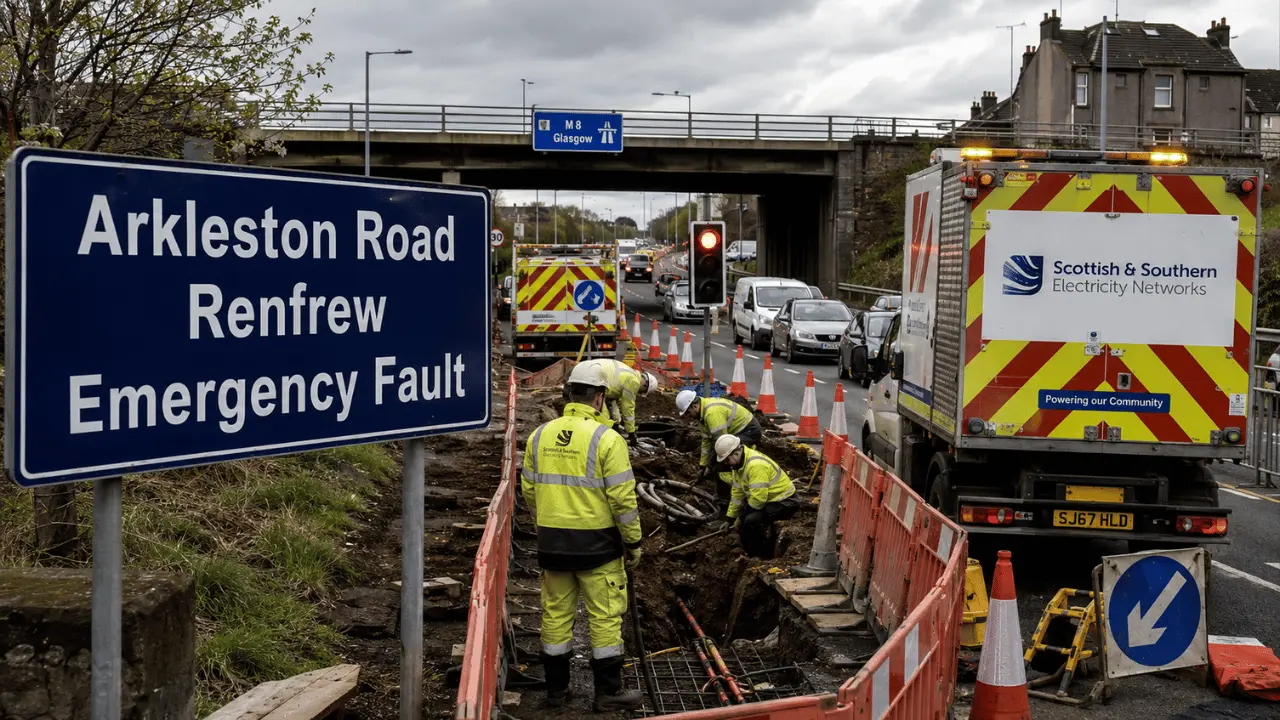
Introduction
Traffic problems are common, but arkleston road renfrew emergency fault became something far more serious than a routine road closure. What looked like another stretch of temporary roadworks was actually an emergency response to a high-voltage electrical failure beneath one of Renfrew’s key transport routes. That distinction matters. Surface repairs can often be completed quickly, while underground utility faults demand careful engineering, strict safety measures, and enough time to ensure the network is safe before traffic returns.
The incident also exposed how closely connected roads, electrical infrastructure, businesses, and daily travel have become. A single failure beneath the surface was enough to affect commuters, nearby residents, public transport, and commercial traffic for an extended period.
Why Arkleston Road Is Such an Important Route
Understanding arkleston road renfrew emergency fault begins with understanding the road itself. Arkleston Road is one of the main links connecting Renfrew with Paisley and surrounding communities. It also carries traffic travelling toward Glasgow Airport and nearby motorway connections, making it far more important than a typical local road.
Thousands of vehicles rely on this route every day. Office workers, delivery drivers, bus operators, emergency services, and residents all depend on it to move efficiently across the area. Because of that heavy use, any unexpected disruption quickly spreads beyond the immediate location.
Unlike planned road maintenance that is scheduled months in advance, emergency utility failures happen without warning. Authorities have little choice but to react immediately, even if that means closing a busy road with very little notice.
What Triggered the Emergency Response
The central issue behind arkleston road renfrew emergency fault was the discovery of a significant underground high-voltage cable fault. Once engineers confirmed the problem, emergency work became unavoidable.
High-voltage electrical cables are part of the network that supplies electricity across the local area. When one of these cables develops a serious fault, engineers cannot simply repair the visible damage. They must first isolate the electrical system, identify the exact location of the problem, and make the site safe before excavation can begin.
Reports indicated that a substantial section of underground cable required replacement rather than a simple repair. That immediately transformed what might have been a short maintenance project into a much larger engineering operation.
The emergency response focused on preventing further damage while restoring long-term reliability instead of applying a temporary fix.
The Location Created Extra Engineering Challenges
The position of arkleston road renfrew emergency fault added another layer of difficulty.
The repair site was located close to the M8 overbridge, an area that already experiences steady traffic throughout the day. Working beneath a busy road near major transport links is never straightforward because engineers must protect both the electrical infrastructure and the road above it.
Excavation work requires heavy equipment, safety barriers, controlled traffic management, and enough space for specialist crews to operate safely. Every metre of excavation has to be carefully planned because underground utility corridors often contain more than one service.
Electricity cables may run alongside telecommunications lines, drainage systems, gas infrastructure, or water pipes. Damaging any of these during repair work would create additional emergencies.
That is why projects involving underground utilities often appear slower than people expect.
Why Underground Electrical Faults Cannot Be Fixed Quickly
One of the biggest misunderstandings surrounding arkleston road renfrew emergency fault is the belief that replacing an electrical cable should only take a day or two.
The visible excavation is only one part of the process.
Before damaged cable can be removed, engineers complete safety testing to confirm the network has been isolated correctly. Once excavation begins, the damaged infrastructure must be inspected to determine whether the fault is limited to one section or whether deterioration extends further underground.
If replacement cable is required, it must be installed according to strict engineering standards before electrical testing begins. Only after successful testing can the excavation be backfilled and the road restored.
Skipping any of these stages would introduce unnecessary risk to both workers and the public.
That explains why emergency infrastructure repairs often continue long after the initial fault has been discovered.
Traffic Management Became Just as Important as the Repairs
While engineers focused on restoring the electrical network, traffic teams had another responsibility—keeping vehicles moving as safely as possible.
The impact of arkleston road renfrew emergency fault extended far beyond the immediate work zone. Closing a key route forces thousands of drivers onto surrounding roads, increasing congestion across neighbouring areas.
Temporary traffic lights, lane restrictions, and diversion routes became essential tools for managing vehicle flow during the repair period.
Although these measures slowed journeys, they also protected both road users and engineering crews working only a short distance away.
Balancing safety with traffic movement is never easy, particularly when the affected road serves both local residents and regional traffic.
The Scale of the Cable Replacement Explained the Delays
Reports surrounding arkleston road renfrew emergency fault indicated that approximately 300 metres of underground cable required replacement.
That figure helps explain why the repair work attracted so much attention.
Replacing a short damaged section might be completed relatively quickly, but replacing hundreds of metres of high-voltage cable involves extensive excavation, specialist equipment, careful installation, and repeated testing before the network can safely return to service.
Every new section must be connected correctly and inspected thoroughly.
Even after installation is complete, engineers continue testing the system before allowing it to carry electrical load.
From the public’s perspective, progress may appear slow because much of the critical work happens underground where it cannot be seen.
Residents Experienced More Than Longer Commutes
The discussion around arkleston road renfrew emergency fault often focuses on traffic delays, but the impact reached further than travel times.
Residents living near diversion routes experienced heavier traffic throughout the day. Streets that normally carried local vehicles suddenly handled much higher volumes as drivers searched for alternative routes.
Bus passengers faced timetable changes, while delivery companies had to adjust schedules to account for additional travel time.
Local businesses also faced challenges when customers found access less convenient during the repair period.
Although none of these problems matched the seriousness of the electrical fault itself, they demonstrate how closely everyday life depends on reliable infrastructure.
Why Public Safety Came First
It is understandable that drivers become frustrated during long road closures.
Still, arkleston road renfrew emergency fault demonstrates why engineering teams cannot allow convenience to override safety.
High-voltage electrical infrastructure presents hazards that are invisible from the surface. Engineers must work in controlled conditions that protect workers, nearby residents, motorists, and surrounding utilities.
Reopening the road before testing is complete would expose everyone to unnecessary risk.
That is why emergency repair schedules are driven by engineering requirements rather than public impatience.
The safest repair is often the one that takes longer but prevents another emergency from happening soon after.
Continuing arkleston road renfrew emergency fault: The Wider Impact Beyond the Repair Site
Earlier Infrastructure Problems Added to the Disruption
One reason arkleston road renfrew emergency fault became such a talking point was that the area had already experienced infrastructure challenges before the underground electrical fault demanded emergency action.
Earlier reports highlighted concerns around the nearby M8 overbridge after a heavy vehicle strike led to structural inspections and traffic restrictions. Although the bridge incident and the cable fault were separate events, they affected the same transport corridor. Drivers who had already become accustomed to delays suddenly faced another unexpected obstacle.
When infrastructure problems overlap, even short journeys can become unpredictable. A route that usually handles steady traffic throughout the day can quickly become congested once diversions push vehicles onto surrounding roads.
That sequence of events explains why frustration grew among commuters despite the repairs being necessary.
Scottish Power’s Role in Restoring the Network
Emergency electrical faults require specialist expertise, and arkleston road renfrew emergency fault was no exception.
Once the damaged section of the network had been identified, engineers focused on restoring a reliable electricity supply rather than delivering the fastest possible repair. Working on high-voltage infrastructure demands careful planning because every connection must meet strict operational and safety standards.
The reported replacement of around 300 metres of underground cable represented a substantial engineering project rather than a routine maintenance visit. Each stage required testing before crews could move on to the next phase.
Electrical faults are rarely repaired by replacing only the visibly damaged section. Engineers also inspect nearby infrastructure to confirm that hidden weaknesses will not create another emergency shortly after the road reopens.
That attention to detail may extend repair times, but it greatly reduces the chance of repeat failures.
Why Temporary Traffic Lights Remained Necessary
Drivers often assume that once excavation work appears to be finished, normal traffic should immediately return.
The reality during arkleston road renfrew emergency fault was more complicated.
Temporary traffic lights allowed engineers to continue working safely while gradually restoring vehicle movement. Instead of reopening every lane immediately, traffic management teams controlled traffic flow around active work areas.
This approach protected both motorists and workers while allowing essential finishing work to continue.
Road resurfacing, equipment removal, safety inspections, and barrier dismantling all require space that cannot safely coexist with unrestricted traffic.
Temporary traffic management therefore remained an important part of the recovery process rather than an unnecessary inconvenience.
The Hidden Cost for Local Businesses
Infrastructure failures rarely affect only drivers.
Businesses located near arkleston road renfrew emergency fault likely experienced reduced customer access throughout the repair period. Shops, cafés, gyms, and service providers depend heavily on reliable road connections.
Customers delayed appointments, delivery vehicles arrived later than expected, and suppliers had to adjust their schedules around traffic restrictions.
Although most businesses understand that emergency repairs cannot be avoided, prolonged disruption can still reduce footfall and increase operating costs.
The financial effect often continues even after roads reopen because customer routines take time to return to normal.
Public Transport Faced Additional Pressure
Bus operators also had to respond to changing road conditions.
When arkleston road renfrew emergency fault restricted one of the area’s key transport routes, scheduled services became more difficult to maintain. Diversions extended journey times and increased the possibility of delays throughout the day.
Passengers travelling to work, school, medical appointments, or transport hubs experienced longer trips than usual.
Unlike private motorists who can sometimes choose alternative routes, bus operators must maintain safe and practical services while following approved diversion plans.
That balancing act demonstrates how one infrastructure fault can affect far more people than those driving through the immediate area.
Emergency Repairs Are Built Around Safety, Not Speed
One criticism that often appears during road closures is that engineers seem to spend long periods without visible activity.
In projects such as arkleston road renfrew emergency fault, appearances can be misleading.
A significant amount of work happens below ground or involves technical testing that is invisible from outside the barriers. Electrical engineers cannot simply reconnect a replacement cable and reopen the road.
Every stage requires inspection, calibration, and verification before electricity is restored safely.
Rushing those procedures could create equipment failures or place workers at serious risk.
For infrastructure carrying high-voltage electricity, careful testing is just as important as the physical installation itself.
Why Preventive Maintenance Matters
The events surrounding arkleston road renfrew emergency fault highlight an issue that affects communities across the United Kingdom.
Large sections of underground utility infrastructure have been operating for decades. While these systems often perform reliably for years, ageing components eventually require replacement.
Waiting until equipment fails creates far greater disruption than carrying out planned maintenance before problems develop.
Preventive investment allows engineers to replace ageing infrastructure under controlled conditions rather than responding to emergencies that force immediate road closures.
Communities may not always notice preventive work, but they certainly notice emergency failures.
Lessons for Drivers During Major Utility Repairs
Road users cannot prevent infrastructure faults, but they can reduce the stress that accompanies them.
Checking travel updates before leaving home becomes especially valuable during emergency repair work. Allowing extra travel time helps avoid unnecessary pressure, particularly during morning and evening peak periods.
Drivers should also respect temporary speed limits and follow official diversion routes instead of attempting shortcuts through residential streets.
Those routes are planned to balance traffic movement with public safety.
Patience may not eliminate delays, but it helps traffic move more smoothly while engineers complete essential repairs.
What the Incident Says About Urban Infrastructure
The discussion around arkleston road renfrew emergency fault reaches beyond one damaged electrical cable.
Modern towns rely on a network of roads, bridges, electricity, drainage, telecommunications, and transport systems that operate together every day. Most people rarely think about these services until one component fails.
The incident demonstrated how quickly underground infrastructure problems can spread into everyday life.
Commutes become longer.
Businesses face reduced accessibility.
Public transport struggles to maintain schedules.
Emergency services must adapt to changing traffic conditions.
All of those effects begin with a fault that remains invisible beneath the road surface.
Looking Ahead After the Repairs
Once emergency work concludes, attention naturally shifts toward preventing similar disruptions.
Utility providers continue monitoring repaired infrastructure, while local authorities assess traffic management measures introduced during the incident. Lessons learned from projects like arkleston road renfrew emergency fault often influence how future emergency responses are organised.
Better coordination between utility companies, road authorities, and traffic management teams can reduce disruption without compromising safety.
Although no infrastructure network can completely eliminate unexpected faults, effective planning helps communities recover more quickly when emergencies occur.
Conclusion
arkleston road renfrew emergency fault became far more than a temporary roadworks project. It exposed how dependent daily life is on reliable underground infrastructure and how quickly one electrical failure can affect transport, businesses, and local communities. While the delays frustrated drivers, the repair programme reflected the reality that high-voltage electrical systems cannot be rushed simply to reopen a road sooner. The lasting lesson is clear: investing in infrastructure before failures occur is always less disruptive than responding after an emergency has already brought an important route to a halt.
FAQs
1. Why did engineers replace such a long section of underground cable?
Engineers replace the full affected section when testing shows that limiting repairs to one small area could leave hidden weaknesses that may fail later.
2. Did the emergency fault interrupt electricity supplies?
The main focus of the repair work was restoring the reliability and safety of the underground electrical network while protecting surrounding infrastructure.
3. Why were diversion routes changed during the repair period?
Traffic management changed as construction progressed. Diversions were adjusted to match each stage of excavation, cable installation, testing, and road restoration.
4. Could weather have affected the repair schedule?
Heavy rainfall, poor ground conditions, or reduced visibility can slow excavation and resurfacing work because safety standards remain the highest priority.
5. What is the biggest lesson from arkleston road renfrew emergency fault?
The incident shows that ageing underground infrastructure deserves continuous investment, because preventive maintenance causes far less disruption than emergency repairs after a major failure.
Read More: Kouskousi: History, Nutrition, Cooking Tips, and Best Uses